2024 Recap
2025 Outlook
- Jorge Lopez, RP
- Josh Bell, 1B
- Michael Soroka, SP
- Trevor Williams, SP
- Nathaniel Lowe, 1B
- Kyle Finnegan, RP
- Tanner Rainey, RP
- Joey Meneses, 1B
- Patrick Corbin, SP
- Joey Gallo, 1B/OF
Welcome to The Dugout Dispatch, Hucky Corp's baseball blog. We'll be sharing our thoughts on all the latest news in the baseball world. We'll be talking about trades, trends, rivalries, and more! Make sure to follow us on twitter if you enjoy our content! https://twitter.com/HuckyCorp
For the second consecutive offseason, a Japanese "Phenom" was available. This time, it didn't cost $700m for his services.
Roki Sasaki, was posted as an international amateur, making him only eligible to sign a minor league deal with a bonus from the teams international signing pool -- a marquee talent at a bargain price for the team that won the "Roki Sweepstakes".
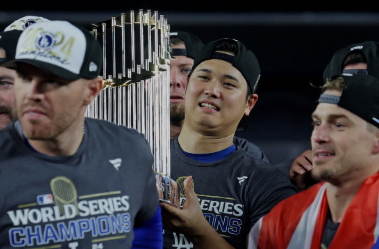
The sweepstakes concluded last night, with Sasaki joining his fellow countrymen Shohei Ohtani and Yoshinobu Yamamoto on the Los Angeles Dodgers, adding to their wealth of Japanese talent and starting pitching.
Sasaki possesses a fastball that can touch triple digits, possibly the best splitter in the world, and a slider that should translate over to the MLB if he regains some velocity. He first burst onto the scene in the last World Baseball Classic, where he was a key player for the Japanese team that won the championship. Over four professional seasons in the NPB, he posted an outstanding 30-15, a 2.02 ERA, a 0.988 WHIP, and 11.4 K/9 rate.
Despite being labeled a "Phenom", expectations should be tempered for the 23 year old star. Historically, Japanese pitchers often need an adjustment period when transitioning to the MLB. Factors like increased competition, adapting to a five-man rotation versus the NPB's weekly rotation, and cultural changes can present challenges.
Let's examine how some highly regarded Japanese pitchers fared in their early MLB seasons.
Yu Darvish signed with the Rangers after they posted a $51.7 million fee to negotiate with him. Darvish agreed to a six-year, $56 million deal (up to $60 million with incentives), bringing the total investment to $107.7 million—the most spent on a Japanese player at the time.
In NPB, Darvish dominated for five consecutive seasons with an ERA under 2.00. His final season stat line was extraordinary: 28 starts, 18-6 record, 232 innings pitched, 1.44 ERA, six shutouts, and a 7.67 K:BB ratio.
However, Darvish needed time to acclimate in MLB. In his rookie season, he posted a 3.90 ERA and a 2.48 K:BB ratio. By his second season, he looked more like the ace Texas had signed, recording a 2.83 ERA and a 3.46 K:BB ratio.
For the second time in two off-seasons, baseball contracts have shattered everyone's expectations. Last year, a 10-year $700 million contract moved Shohei Ohtani from the Los Angeles Angels to their NL Rival Los Angeles Dodgers, shattering what was expected to be a 500 or maybe even a 600m contract
Last night, history repeated itself, with the 26-year-old Juan Soto moving from New York Yankees to the cross-town rival Mets, on a 15-year, $765 million (with the potential to top $800 million) that completely shattered all expectations of a $650-$700m contract.
What if the key to baseball’s future lies in a strategy that only one team can currently pull off?
As the Winter Meetings approach, the Los Angeles Dodgers bold approach to contracts has helped them set the foundation for a dynasty, potentially redefining how teams approach roster construction in the process.
Meanwhile, the Soto sweepstakes loom large, promising to shape the offseason in dramatic fashion. Let’s dive into why the Dodgers’ new strategy might be good for baseball—and how the Juan Soto saga is playing out so far.
Rankings based on The Athletic's big board.
At 26, Juan Soto remains a generational offensive talent, often compared to Ted Williams for good reason. He’s coming off the best offensive season of his career, but his defense in right field and baserunning were subpar. It wouldn’t be surprising to see him transition to DH in the near future, depending on his next team.
Expect Soto to land a record-breaking contract—probably starting with a $6—given his proven track record. The Yankees and Mets seem like the primary suitors, but don't sleep on the Red Sox, Phillies, Blue Jays, and Dodgers. With their financial resources, Soto’s one-dimensional skillset becomes an afterthought. For teams with money to spend, he’s worth every penny.
Burnes is the only proven ace on the market. The former Cy Young winner has silenced critics over the last three years by delivering consistent workloads, averaging nearly 200 innings per season. His dominance, highlighted by an eight-inning, one-run gem in his final 2024 start, makes him the top pitcher for teams looking to contend immediately. Look for the Mets to be all over Burnes as they look to land a frontline starter to anchor their rotation. Wouldn't be surprised if the Giants, Blue Jays, and Red Sox are in on him as well.
The Japanese phenom enters free agency as one of the most exciting arms available. Sasaki boasts a triple-digit fastball, a devastating splitter, and ace potential. If his slider carries over, he'll be one of teh best pitchers in the sport and will only cost a team international pool money and a minor league contract due to MLB posting rules, making him a must-target for every team. His upside rivals—or even exceeds—that of recent standout Yoshinobu Yamamoto.
Fried’s elite groundball rate (59.2%) and ability to induce weak contact make him a solid No. 2 starter for a contender. However, he lacks the swing-and-miss dominance of an ace. While he outperformed his xERA in 2024 (3.64 xERA vs. 3.25 ERA), his profile suggests more of a steady, reliable option than a frontline star. He grew up a Dodgers fan and they would be happy to have him, but also wouldn't be surprised if the Orioles, Braves, Mets, Giants, and Cubs take a run at him as well
If you miss out on Burnes and want a number 1 starter, Snell is your next-best option. Despite battling injuries, Snell finished the season strong for a second consecutive year, boasting a jaw-dropping 34.7% strikeout rate. He’s likely to command a shorter deal with a high AAV, making him an intriguing target for contenders seeking flexibility. When he's healthy and on, he's one of the best pitchers in the game. I'd like to see the Mets take a run at Snell if they miss out on Burnes but also could see the Yankees, Padres, and Dodgers taking a long look.
Adames quietly had a fantastic 2024, blending power (32 HRs) with newfound speed (21 SBs). One of the league’s better offensive shortstops, he’s also a plus defender at a premium position. While the Brewers would love to keep him, his price tag likely pushes him out of Milwaukee’s plans. He's also said he's willing to move to second or third base if asked. Look for the Dodgers, Blue Jays (if they trade Bichette), and Braves to be highly interested in him.
Bregman’s willingness to switch to second base broadens his appeal, where he would instantly become one of the best offensive options at the position. Though his OBP dipped in 2024, his ability to control the strike zone and limit strikeouts while still providing some slug keeps him valuable. Defensively, his below-average arm strength (which would be nullified by a move to second) has not stopped him from being a plus defender. I think the Astros are going to do everything to keep him in Houston.
Alonso didn’t quite match his career averages in 2024, but he still provided power (34 HRs) and clutch performances in the Mets’ playoff run. First base is an offensive position, and Alonso remains one of the best right-handed power bats in the entire league. The Mariners and Nationals would both benefit from a proven slugger
Santander exploded for 44 home runs in his walk year, solidifying himself as a premier power bat. While his .235 batting average suggests a tradeoff for power, his strikeout and walk rates remain reasonable and he won't be paid to hit a bunch of singles. As a switch-hitter with fantastic pop, he’s a perfect fallback option for teams missing out on Soto. I would love to see him on the Mariners, but also see the Giants, Padres, and Royals (if they want to open the checkbook) being a good fit for him
Flaherty delivered when it mattered most, starting Game 1 of the World Series for the champions. Concerns about his health faded in 2024, as he pitched 162 innings with elite strikeout numbers. Without a qualifying offer attached, the team who signs Flaherty will get a number 2 starter without having to lose a draft pick or pool money. A return to the Dodgers would probably be his top choice, but the Tigers, Orioles, Cardinals and many other teams should be looking to acquire his services
Hernández rebounded with a strong offensive year, including a .840 OPS and 33 home runs. His bat was crucial to the Dodgers’ playoff success, and his right-handed power complements their lefty heavy stars. While his defense is below average, his bat should make him a priority for any power-needy contender. The Dodgers should reward him with a long term contract, but the Yankees, Mariners, Giants, Royals, and Guardians are intriguing options as well.
A midseason mechanical adjustment turned Manaea into the Mets’ best pitcher down the stretch. His crossfire delivery, reminiscent of Chris Sale, makes him especially effective against lefties. At 32, he’s more of a mid-rotation option but could have No. 2 upside if his mechanics continue to shine.
Eovaldi enters free agency at 35, looking for a shorter deal. Though not a frontline starter anymore, he’s been a steady presence for the Rangers over the past two seasons. He profiles as a No. 3 starter on a competitive team.
Kikuchi impressed after being traded to the Astros at the deadline, posting a 2.70 ERA and a career-best 3.07 FIP over 60 innings. His WHIP also dipped below 1. At 33, Kikuchi won’t demand a long-term deal, making him a great target for teams seeking a No. 2 or 3 starter with upside. A return to the Astros makes a lotta sense for both parties
Walker offers a mix of power and defense, making him a more cost-effective alternative to Alonso. An elite glove at first base and consistent power production (20+ HRs for four straight seasons) ensure he’ll draw plenty of interest. Wouldn't be surprised if he signs before Alonso since he's a shorter (and cheaper) commitment.
Kim’s defensive versatility and elite strike zone control make him an ideal role player for contenders. While his bat isn’t flashy, his glove and consistency could be a great fit for teams like the Dodgers if they miss on Adames.
Profar broke out in 2024, posting an OPS over 100 points higher than his career average. Though his defense and baserunning are average at best, his newfound offensive prowess makes him a worthy gamble as a middle-order bat.
Despite a rough first half, Torres found his groove after the all star break and throughout the playoffs. Though inconsistent on defense and the basepaths, his offensive upside makes him one of the better-hitting second basemen in the sport. At 28 years old, he could be the steal of Free Agency.
Scott emerged as the best reliever available at the trade deadline and enters the offseason as the best arm available. Traded for a significant return at the deadline, his elite fastball and high-leverage experience make him a premium bullpen arm. At just 30, he’s young enough to anchor a bullpen for the next several seasons before his fastball stats to fade.
Bieber was injured after just 12 (shutout) innings in 2024 and will miss most of 2025. His velocity has been dipping for a while now, but the ex-Cy Young winner still showed flashes of brilliance in limited action. Expect him to sign a short-term, incentive-laden deal as teams bet on his recovery.
Similar to Bieber, Buehler’s health adds uncertainty to his market. He struggled in 2024 but flashed his potential during the postseason. His future might be in the bullpen as a fireman if it'll keep him healthier. Pre-injuries, Buehler looked like a Cy Young contender and hopefully he can get close to that level again.
When healthy, O’Neill is an impact right-handed bat. In just 113 games for the Red Sox in 2024, he smashed 31 home runs, showcasing his immense power potential. However, durability remains a concern, as he has struggled to stay on the field throughout his career. Look for teams who miss out on Teoscar Hernadez/Santander to look at O'Neill.
Severino rebounded in 2024, leading the Mets' rotation with a 3.91 ERA after two injury-riddled seasons. While he lacks ace-level dominance, he’s a steady middle-of-the-rotation option with the ability to eat innings. His injury history might hurt his
Hoffman has quietly become one of the most consistent relievers in baseball. Over the past two seasons, he’s posted ERAs of 2.41 and 2.17, while maintaining elite strikeout and chase rates (96th percentile). He can anchor a bullpen and won't cost as much as Tanner Scott
Martinez offers versatility as both a starter and reliever. In 2024, he started 16 games while posting a 3.10 ERA and a 1.03 WHIP. His ability to limit walks and hard contact makes him a great fit as a No. 4 starter with upside. Martinez has accepted the Reds qualifying offer, and will make just over $20m this season.
The stage is set! We’re down to the final four, with three of the four top seeds making it to the final four.
In the American League, the top seeded Yankees and second seed Guardians have lived up to their playoff expectations and are the last two standing. Over in the National League, the Dodgers and Mets are set to clash. For the third consecutive year, a 6-seed has made it to the NLCS (the previous two, the Diamondbacks and Phillies, both advanced to the World Series).
Its been a bad year for stingy owners, with three of the four remaining teams-- the Mets ($317 million), Yankees ($309 million), and Dodgers ($241 million) ranking among the top five payrolls in baseball. The Guardians, on the other hand, come in at just $106 million (23rd), giving them a true underdog feel heading into this round.
The magical Mets continue their run despite this being a retooling year after eliminating the Phillies in four games. The Mets' pitching rotation remains a strength, with Kodai Senga likely starting Game 1, (possibly followed by David Peterson). Luis Severino will take the ball for Game 2, with Sean Manaea and José Quintana expected to handle Games 3 and 4.
The starters were lights-out against Philadelphia, but concerns remain about the bullpen. Edwin Díaz has thrown a ton of pitches lately and needed these extra rest days, but his recent outings have been a bit shaky. The biggest question facing these Mets is who manager Carlos Mendoza can rely on to get key outs in high-leverage spots,.
The Dodgers, on the other hand, survived a nail-biting series against their new biggest rivals, the Padres. The Dodgers advance on the back of a dominant bullpen performance to shut down San Diego’s offense for the final 24 innings – nearly three full games! Teoscar Hernández carried the offense in the NLDS, but if they want to take down the Mets, Mookie Betts, who posted a scorching .889 OPS, will need to stay hot. Shohei Ohtani struggled in the NLDS, posting a .623 OPS, and they'll need more from him, especially with Freddie Freeman’s ankle still a lingering concern.
The Dodgers' starting pitching remains a concern. The best start from a Dodger in the NLDS, Yamamoto’s Game 5 performance against the Padres where he went five scoreless innings, featured a lot of loud outs. Walker Buehler, their presumable Game 2 starter, was shelled for six earned runs over five innings without recording a single strikeout. Dave Roberts will have to be strategic in how he handles his bullpen, especially since they might have to play three straight games without a day off once the series moves to NY.
Despite the Mets’ bullpen issues, their starting rotation has given them quality lenth, and their magical run doesn't seem to be slowing down. The Dodgers have plenty of offensive firepower and a strong bullpen, but I’m predicting the Mets pull this one off in six games. Mets in 6.
In the American League, the Yankees and Guardians square off in a battle of the top two seeds.The Yankees made it past the Royals in four games, though they benefited from a questionable replay in Game 1. Regardless, they were the better team and their bullpen was untouchable throughout the ALDS, not allowing a single earned run. Giancarlo Stanton’s bat has come alive at just the right time, continuing his historic postseason form, while Aaron Judge was relatively quiet. If the Yankees want to advance, they’ll need Judge to return to his regular season MVP-caliber level.
The biggest question for New York is their starting pitching. Gerrit Cole is a rock at the top of the rotation, and Clarke Schmidt should be able to give them four to five solid innings. However, Carlos Rodón’s performance is crucial. He’ll need to show more of what he displayed in the first inning of Game 2, rather than the rough fourth inning that followed. The Yankees have arguably their best team since 2017, but they’ll be up against the best bullpen in baseball.
The Guardians survived a five-game series against the Tigers, thanks in large part to their bullpen and some timely hitting. Tanner Bibee remains their only reliable starter, which puts even more pressure on their elite bullpen. Offensively, Lane Thomas’s grand slam off Tarik Skubal in Game 5 was the turning point, but Cleveland will need players like Steven Kwan and David Fry to remain productive if they want to break through against New York’s arms. The Yankees have a history of avoiding José Ramírez, and they’ll likely continue this strategy after shutting down Bobby Witt Jr in the ALDS.
While Cleveland’s bullpen is better than everyone else's, the Yankees simply have the better roster on paper. Their offense has more firepower, and the bullpen is peaking at the right time. The Guardians’ extra game in the ALDS might also leave their arms slightly more fatigued. With that in mind, I’m picking the Yankees to win this series in five games. Yankees in 5.
We're one step closer to crowning the 2024 MLB Champions. The wild card round was full of excitement and upsets, setting the stage for an exciting (and surprising?) divisional round.
For the first time in years, the AL Central is shaking off its reputation as the weakest division in the American League. Three of the four remaining AL teams hail from the Central, giving us the potential for an all-central ALCS, a scenario almost no one predicted at the start of the season.
Over in the National League, the matchups are just as enticing, fueled by new and old rivalries. The Padres will head to Los Angeles in hopes of finally toppling the Dodgers, while the Mets and Phillies gear up for a showdown that promises fireworks—not just on the field, but in the stands, where two of baseball's most passionate fanbases will clash.
A five-game series may not have the same unpredictability as the best-of-three Wild Card round, but recent years have shown that anything can happen in October. Let’s dive into each team's biggest Key to Success
Detroit Tigers: AJ Hinch's Masterclass
Tigers’ manager AJ Hinch has orchestrated one of the most remarkable turnarounds in recent memory. Whether it's strategic in-game decisions or lineup management, Hinch has pushed all the right buttons, getting the most out of a team that, on paper, shouldn't be in the playoffs.
Their ace is arguably the best starter in baseball, but outside of Skubal, nobody on this Tigers roster should scare another team. For Detroit to get past a strong Cleveland team, Hinch must continue his tactical wizardry.
Cleveland Guardians: Get the Ball to the Bullpen
Cleveland boasts the best bullpen in the league, led by the nearly unhittable Emmanuel Clase. With four relievers capable of closing games, (soon-to-be) Manager of the Year Stephen Vogt's job is simple—get the ball to his elite bullpen with a lead and let them attack.
For that to happen, the Guardians’ starters and lineup need to do their part by jumping out to early leads, allowing Vogt to unleash his bullpen aggressively.
Kansas City Royals: Supporting Cast Behind Bobby Witt Jr.
It’s no secret that Bobby Witt Jr. is the heart and soul of the Royals, but if they’re going to beat the Yankees, they’ll need contributions from other hitters. Maikel Garcia’s performance against the Orioles was a bright spot, creating the only run in Game 1, and the return of “The Pasquatch,”, played a pivotal role in the Game 2 victory.
While the Royals’ rotation (and bullpen) has the edge over the Yankees, none of that will matter if the offense doesn’t step up. They can’t afford to rely on Witt Jr. alone.
New York Yankees: Starting Pitching Must Deliver
Gerrit Cole found his stride in September, and the Yankees will need him to continue that form if they want to make a deep playoff run. But beyond Cole, New York’s rotation is riddled with uncertainty. Carlos Rodon has been up and down, and Luis Gil has shown flashes of brilliance mixed with command issues.
The Yankees' bullpen has improved as of late, but no one in the Bronx will feel comfortable if this series comes down to a battle of the bullpens. Boone must manage his rotation wisely to avoid those late-game situations against Kansas City’s strong bullpen.
Philadelphia Phillies: Can the Pitching Staff Rebound?
Few teams have experienced a more dramatic fall-off in pitching performance than the Phillies. After dominating the first half of the season, Philadelphia’s staff has regressed from the best staff in baseball, to posting the 20th worst ERA in the second half. If they want to avoid an early exit (and painful upset), the pitching needs to return to its early-season form.
New York Mets: Keep the Magic Alive
The Mets have captured the nation’s attention with their wild week. After pulling off a miraculous comeback to clinch a wild card spot on Monday, they followed it up by forcing Devin Williams into the worst outing of his career in a win-or-go-home game against the Brewers.
The Mets’ boast potentially the weakest roster of the remaining NL teams, but that hasn't mattered. There’s something special about this team, and if they can keep the momentum going, they could be a force to be reckoned with.
Los Angeles Dodgers: Yamamoto, Then What?
The Dodgers will ride with their $325m ace, Yoshinobu Yamamoto, in Game 1, and if necessary, Game 5. After him, though, question marks abound. JFlare’s performance has dipped after a stellar start to the season in Detroit, with veterans like Clayton Kershaw and Tyler Glasnow unavailable due to injury and no other starters stepping up down the stretch, it'll be interesting to see how the Dodgers approach games 3 and 4.
Could the Dodgers take a risk and start Michael Kopech in a critical Game 3 or 4? Given the uncertainty surrounding the rest of the rotation, it might be their best option.
San Diego Padres: Stay the Course
The Padres have been baseball’s best team since the All-Star break. Even with the loss of Joe Musgrove to Tommy John surgery, San Diego’s pitching staff is the strongest of the remaining playoff teams.
On the offensive side, Fernando Tatis Jr. has rediscovered his form, and his playoff performances have reminded everyone just how dangerous (and electric) he can be. The Padres’ star-studded lineup and balanced pitching give them a strong chance of toppling their division rival, the Dodgers.
As we approach the stretch run of the 2024 season, the landscape is more unpredictable than ever. There is no clear-cut "favorite", as the best teams in the league have legitimate flaws, and no team seems destined to reach the elusive 100-win mark. The playoff picture is a chaotic mix of flawed contenders and surging underdogs, setting the stage for what could be one of the most thrilling postseasons in recent memory.
Looking toward the future, the MLB is reportedly considering a major rule change that would redefine the role of the (modern) starting pitcher, potentially altering the strategy and dynamics of the game. In this post, we’ll explore the rollercoaster ride that is this year’s playoff race and delve into the implications of this proposed new rule for starting pitchers.
As we approach the final stretch of the season, a 100-win season for any team looks like a longshot. I ran a poll in the "Baseball Worldwide" Twitter community asking which team is most likely to reach the century mark in wins this year, with the Orioles leading with 50% of the vote.
However, the most realistic answer is probably no team.
As of 8/19, the Phillies boast the best winning percentage in baseball at .589, which translates to a 95-win pace. Not far behind are the Yankees, Dodgers, and Orioles (.584), who are then closely followed by the Guardians and Brewers (.581). Digging deeper into each team reveals some significant question marks that make a 100-win season even more unlikely.
Team Weaknesses
However, because of this balance at the top of the league, the playoff picture is far from settled, as some teams have come out of the All-Star break red hot and have made the AL West, AL Central, and NL West extremely fun
Hot Teams Making a Push
The AL East, in particular, is shaping up to be a thrilling finish, with the Orioles and Yankees seemingly begging each other to take the division lead. It might all come down to the last three games of the season between these two storied rivals.
Meanwhile, despite their post-break slump, the Phillies are still 7 games clear in the NL East and will likely cruise to a division title, thanks to their strong first half.
![]() |
| Overall Records as of 8/20 |
Last week, reports emerged that MLB is considering a rule change that would require starting pitchers to pitch at least 6 innings with some exceptions. The exceptions are:
This proposal aims to bring more value back to the starting pitcher role. In an era where it's rare to see a starter go beyond five innings, this rule aims to bring back the value of the starting pitcher.
Impact on Pitcher Training
If implemented, this rule would likely change how pitchers train and prepare. Rather than focusing solely on maximizing strikeouts, pitchers would need to balance effectiveness with the ability to navigate the opposing lineup three or more times. This could lead to a resurgence in the value of pitching to soft contact and command over pure velocity.
Market Value of 2-4 Starters
The market value for solid 2-4 starters would likely skyrocket under this new rule. While aces like Gerrit Cole, Corbin Burnes, and Justin Verlander are already highly valued, pitchers who can consistently deliver quality 6-inning starts would become even more coveted as teams would no longer be able to rely as heavily on elite bullpen arms to cover half the game.
Issues with the Proposed Exceptions
While the idea is intriguing, the proposed exceptions need some refining.
100 Pitches: The 100-pitch limit is arbitrary and doesn't account for a pitcher's condition. Advanced metrics now allow us to better assess when a pitcher is tiring, such as changes in arm angle or stride length. This fixed number could be problematic, especially for the start of the season or for pitchers returning from injury who are still building up their stamina.
Four or More Earned Runs: This exception seems reasonable at first glance, but could lead to unintended consequences. For example, a pitcher who unravels after a couple of errors might still be forced to keep pitching, even though the game is slipping away. Moreover, down the stretch, if a team is facing an opposing ace, they might prefer a solid 5-inning, 3-run performance from their 5th starter. With this rule, they could be forced to take a chance on that starter facing the lineup for a third or fourth time, risking the game being pushed out of reach.
Injury Concerns: The injury exception is also problematic. Often, pitchers are removed as a precaution to avoid more severe injuries. Under this rule, pitchers might downplay their injuries to avoid an IL stint, potentially leading to worse outcomes. Additionally, minor issues like blisters, which can severely impact a pitcher's effectiveness, wouldn't qualify for an early exit, possibly leading to more runs and a forced removal under the earned runs rule.
2024 Recap Record: 71-91, 4th in NL East, Missed Playoffs The Nationals finished 2024 with the exact same record as 2023, a rare feat. Howe...